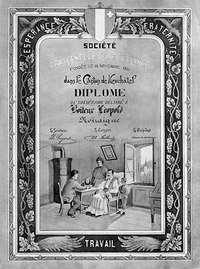
Various terms are used to denominate modern social policy systems. Among the Swiss public sphere, the term ‘social insurance’ has been dominant since the 19th century. In comparison, alternative designations such as ‘social state’, ‘welfare state’ or ‘social security’ are used more rarely or only among experts.
Topics
-
Social security terms
-
Social security solidarity models
Systems of social security are legitimized by various ideas; these ideas also determine the organizational forms adopted. Reciprocity, subsidiarity and solidarity are three of these ideas.
-
Employment Status and Social SecuritySocial security is linked in many ways to employment status. Those in paid employment are better covered, often, than those whose work goes unpaid. Moreover, many social insurance schemes base their financing model on employment-related contributions. Gainful employment includes productive work performed by employees or by the self-employed. Yet, not all work counts as gainful employment. Unpaid work such as housework, helping out neighbors, or volunteering – work predominantly performed by women – is excluded.
-
International social security organisationsThe history of the Swiss welfare state is intertwined with international organizations committed to social policy. They exerted considerable influence on Switzerland, albeit often in an indirect and informal manner.
-
Swiss welfare state in an international comparisonSwitzerland was long considered a laggard when compared to other welfare states. Based on its expenditures for social welfare purposes, it now ranks in the upper middle range. Among the peculiarities of the Swiss welfare state, one should note the importance of federalism and individual provision, the influence of private facilities and the low share of fiscal means used to finance social security.
-
Direct Democracy and the Welfare StateSwiss citizens are able to directly influence political affairs and call for a vote by means of initiatives and referenda. These direct democracy instruments have had a substantial effect on the emergence and development trajectory of the Swiss welfare state.
-
Federalism and Cantons
The Swiss welfare state is shaped strongly by federalism. On the one hand, this reduces the Confederation’s scope for action in social policy. On the other hand, it allows cantons and cities to become pioneers in developing the welfare state.
-
GenderDo men and women have an equal right to social security? This question arises on the one hand for gender-specific risks, such as maternity, and on the other relative to access to social insurance. Access to social insurance is highly dependent on employment status, meaning gender differences in employment histories are reflected in entitlements to social security.
-
GenerationsSolidarity between the generations is important for social security systems to work properly, particularly for the AHV (old age and survivors’ insurance) and healthcare insurance. In addition to the redistribution provided by the welfare state, family solidarity between generations is also effective.
-
Calculated Solidarity: The Debate on the Basis of Calculation for Assistance Funds and Social Insurance Before 1900Towards the end of the 19th century, social insurance schemes were still relatively unknown. However, the broad support of the population was critical for the expansion of the Swiss welfare state. The technical reliability of social insurance seemed to offer a major advantage. Advocates of the welfare state often pointed out that social insurance schemes were based on mathematical and statistical foundations. At the same time, authorities and experts criticized the purportedly unscientific practices of existing private assistance funds.
-
Financing and Calculation Models in Old Age and Survivors’ Insurance (AHV)Mathematics and statistics have been important tools in the history of old age and survivors’ insurance, notably in terms of planning its development and financing. In the 1920s and 1930s, prior to the introduction of the AHV, the Confederation published a number of different forecasts. Calculations on the amount and adjustment of AHV pensions as well as the distribution of contribution obligations followed after 1948.
-
Cost Development and Funding of Health Insurance
Costs issues have been at the heart of political debates on healthcare since the 1960s. Concerns have been raised about the ongoing ‘cost explosion’ on the one hand and, on the other, there have been numerous discussions regarding reforms to healthcare funding.